We Do Books™ Blog
The information provided on this site is for general informational purposes only and should not be construed as professional financial, tax, or legal advice. For advice tailored to your specific situation, we recommend consulting with a qualified professional. We Do Books is here to assist by calling 855-922-WeDo (9336)
Paying the Government by Check: Still Allowed, Still Risky

Paper checks are not dead, but they are wheezing in the tax-payment ICU.
For decades, taxpayers paid the IRS, state agencies, property tax offices, and other government departments by writing a check, stuffing it into an envelope, and trusting the mail, the bank, and the government’s processing system to behave like responsible adults. That was optimistic then. It is even more optimistic now.
Today, federal agencies are moving toward electronic payments. The IRS has said that mailed payments, including checks and money orders, are still accepted for now, but the agency is reducing its reliance on paper payments and will continue transitioning toward electronic methods over time. The IRS also encourages taxpayers to use electronic payment options to avoid delays.
That does not mean every check will create a problem. It means when a check does create a problem, the cleanup can be painfully slow, like trying to explain depreciation to a raccoon.
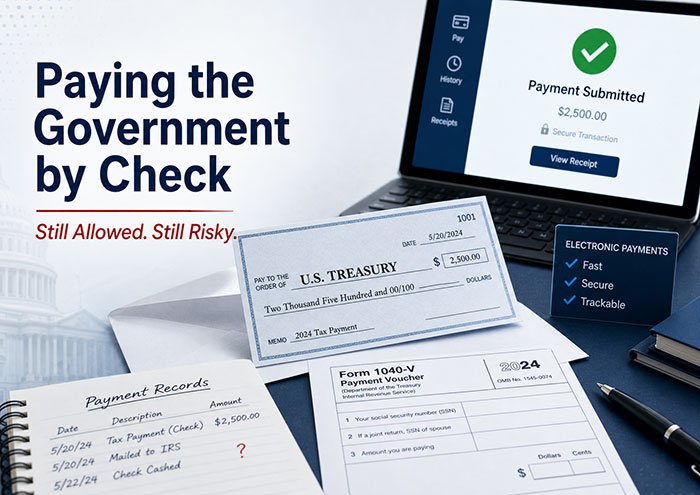
Why paying taxes by check can create problems
When you pay electronically through an official government portal, the payment generally includes structured information: taxpayer name, tax year, tax form, payment type, confirmation number, and payment date. When you mail a check, all of that information depends on what is written on the check, what is included with the voucher, how the payment is processed, and whether the agency posts it correctly.
That is a lot of moving parts for something this important.
The IRS currently says that if you mail a check, money order, or cashier’s check, it should be payable to U.S. Treasury, and it should include the taxpayer’s name and address, daytime phone number, tax year, related form or notice number, and SSN, EIN, or ITIN for the person who should receive credit for the payment. The IRS also says not to staple or paper clip the payment to the voucher or return.
Miss one of those details, and your payment may still cash, but that does not guarantee it was applied correctly. “The money left my account” is not always the same as “the government credited the right taxpayer, tax year, and tax form.” Unfortunately, the IRS does not award points for effort, vibes, or beautifully handwritten memo lines.
The canceled check may not exist anymore
Years ago, a canceled check was the gold-standard proof of payment. Today, many taxpayers never receive the original check back. Under Check 21, banks can process checks electronically, create substitute checks, and in many cases the original paper check may be destroyed. The Federal Reserve explains that substitute checks can be legally the same as the original check, and that the IRS will accept a substitute check as proof of payment.
That is helpful, but it also means taxpayers should not assume the original paper check will be available later. Banks are not required to keep original checks for a specific length of time, and many taxpayers only have access to check images for a limited period through online banking.
In plain English: download your proof while it still exists. Banks are not sentimental scrapbookers.
The IRS may convert your check into an electronic payment
There is another fun little wrinkle. The IRS says that when you provide a check, you authorize the IRS either to use the information from your check to make a one-time electronic funds transfer or to process it as a check transaction. If it is converted electronically, funds may be withdrawn as soon as the same day the IRS receives the payment, and you will not receive the check back from your financial institution.
So even when you “pay by check,” the payment may not behave like an old-fashioned check. It may become an electronic transaction wearing a paper-check costume.
The mailbox problem: timely mailed is not always stress-free
Taxpayers often rely on the rule that a return or payment is treated as timely if it is postmarked by the due date. That rule is important, but the postmark is the key. The Taxpayer Advocate Service has warned that newer USPS processing rules may cause the postmark date to be later than the date a taxpayer actually drops mail into a mailbox. For deadline-sensitive filings or payments, TAS recommends paying electronically when possible, or going to the post office counter and obtaining dated proof of mailing.
Example: A taxpayer drops a check in a blue mailbox on April 15. The envelope is not postmarked until April 16. The taxpayer may now have a timing problem even though they swear, truthfully, that they mailed it on time. The tax system is not famous for caring about sworn emotional testimony.
Business payroll deposits are a different beast
For businesses, payroll tax deposits are especially important. The IRS says federal tax deposits must be made by electronic funds transfer, and free options include the business tax account, Direct Pay for businesses, and EFTPS.
For Forms 941 and 944 employment tax deposits, the IRS states that deposits must be made electronically through a business tax account, Direct Pay for businesses, or EFTPS. The IRS also warns that penalties may apply for mailing payments directly to the IRS instead of depositing the amounts when a deposit is required.
Example: A business owner mails a check with a payroll tax form because that is how they have always paid things. The check eventually clears, but the deposit was required electronically and was due before the return filing date. Result: possible failure-to-deposit penalties. The check did not solve the problem. It politely arrived late to the wrong party.
Examples of check-payment problems
Example 1: The payment clears but posts to the wrong year
A taxpayer mails a $12,000 check for a 2025 balance due but forgets to write the tax year and form number on the memo line. The check clears. Months later, the taxpayer receives a notice for unpaid 2025 tax because the payment was applied to a prior-year balance.
To fix it - the taxpayer may need the front and back of the canceled check or substitute check, the bank statement, the tax return, the payment voucher and the IRS account transcripts.
Example 2: The bank’s online bill pay sends a paper check
A taxpayer uses their bank’s bill pay system to “pay the IRS.” The bank does not send an IRS electronic tax payment. Instead, it prints and mails a physical check from a payment center. The memo information is limited, the voucher is not included, and the taxpayer assumes everything is fine because the bank screen says “sent.”
Later, the IRS sends a balance-due notice. The taxpayer’s bank statement shows money left the account, but now the issue is whether the IRS credited the payment correctly.
A bank bill-pay record may be useful, but it is usually not as clean as paying through an official IRS or state tax portal.
Example 3: The estimated tax payment is made for the wrong spouse
A married couple files jointly. One spouse uses a separate bank account to pay an estimated tax payment by check, but the memo line lists the secondary spouse’s SSN. The IRS account activity becomes messy, especially if prior-year notices or separate assessments exist.
When paying electronically, the taxpayer can usually identify the correct taxpayer, payment type, and year more clearly. When paying by check, the IRS instructions become extremely important.
Example 4: The state tax notice gets paid, but not the notice
A taxpayer receives a state tax notice for 2022. They mail a check with “tax payment” in the memo line but do not include the notice ID. The state cashes the check but applies it to the oldest balance or a different period.
The taxpayer now gets another notice. The state is not saying it did not get the money. It is saying the money took a wrong turn inside the bureaucracy maze.
Example 5: The property tax check disappears
A homeowner mails a check to the county tax collector close to the deadline. It is delayed, lost, or stolen. The taxpayer cancels the check and issues another one, but the payment is now late. Penalties and interest may apply depending on local rules.
Electronic property tax portals are not perfect, but they usually provide immediate confirmation. Paper checks provide hope. Hope is not a recordkeeping strategy.
What to use instead
For federal individual taxes, IRS Direct Pay allows taxpayers to pay from a bank account for free, without signing in, and to change or cancel a scheduled payment within two days of the scheduled date.
Direct Pay can also provide a confirmation number and optional email confirmation. The IRS says taxpayers should still verify that the payment was successfully processed by checking their online account or bank activity after the scheduled payment date.
For businesses, the IRS lists several electronic payment options, including the business tax account and EFTPS. EFTPS allows users to schedule payments, track payments with email notifications, and view payment history.
For state and local taxes, use the official agency portal whenever possible. Save the confirmation page, email receipt, and bank debit record. The goal is to create a clean trail that says:
Who paid, what was paid, when it was paid, how much was paid, and what tax period it applied to.
That is the recordkeeping pentagon. Less glamorous than a superhero team, but more useful in an audit.
What proof should you keep?
For any tax payment, keep the following:
| Payment type | Records to keep |
|---|---|
| IRS Direct Pay or state portal | Confirmation page, email confirmation, bank statement, screenshot of posted payment |
| EFTPS | EFTPS confirmation, payment history, bank statement |
| Credit card or digital wallet | Processor confirmation, card statement, agency confirmation |
| Mailed check | Copy of check before mailing, payment voucher, proof of mailing, bank statement, front and back check image or substitute check |
| Notice payment | Copy of the notice, confirmation or check image, proof that the payment was applied to the notice |
For deductions, remember that proof of payment alone is often not enough. You usually need proof of the underlying transaction as well: invoice, receipt, contract, charitable acknowledgment, medical statement, or other documentation showing what was purchased or paid.
For charitable contributions, IRS guidance states that a donor generally must keep a record of the contribution or a timely written communication from the charity showing the organization’s name, date, and amount. The IRS also recognizes records such as bank records, electronic funds transfer receipts, canceled checks, scanned images of both sides of a canceled check, and credit card statements.
When paying by check is unavoidable
Sometimes a check is still necessary. Some agencies, notices, older systems, or unusual payment types may require or allow it. When that happens, do not just write the check and hope the paperwork elves handle the rest.
Use this checklist:
- Make the check payable exactly as instructed.
- Write the taxpayer name, tax ID, tax year, form number, and notice number on the check.
- Include the correct voucher or notice stub.
- Mail it to the exact address listed in the instructions or notice.
- Use a mailing method that gives dated proof of mailing when close to a deadline.
- Keep a copy of everything before mailing.
- Download the front and back check image once it clears.
- Confirm the payment posted to the correct account and period.
The bottom line
Checks still work, until they do not. And when they do not, the taxpayer is often the one stuck proving that the payment was made, received, processed, and applied correctly.
Electronic payments are not perfect, but they usually create better records, faster confirmation, and fewer posting issues. For taxpayers, that means less time chasing notices. For business owners, it means fewer payroll deposit headaches. For everyone else, it means one less envelope floating through the tax wilderness with thousands of dollars and a prayer inside.
The best tax payment is not just one that clears the bank. It is one that can be proven, traced, and matched to the correct taxpayer, tax year, and tax form.
FAQs
Is it safe to pay the IRS by check?
Paying the IRS by check is still allowed in many cases, but it can create delays and recordkeeping issues. Taxpayers should keep a copy of the check, payment voucher, proof of mailing, bank statement, and front and back check image once the payment clears.
What should I write on a check to the IRS?
A tax payment check should include identifying information such as the taxpayer name, tax ID number, tax year, form number, and notice number if applicable. The check should be payable exactly as instructed by the IRS or government agency.
Is electronic payment better than mailing a tax check?
Electronic payment is often better because it usually provides a confirmation number, payment date, payment amount, and tax period. That makes it easier to prove the payment was made and properly directed.
What proof should I keep when paying taxes by check?
Keep the check image, bank statement, payment voucher, notice, proof of mailing, and any account transcript or confirmation showing the payment was applied correctly.
Can a tax payment check clear but still be misapplied?
Yes. A check can clear the bank but still be applied to the wrong tax year, tax form, taxpayer account, or notice. That is why taxpayers should confirm the payment posted correctly.
When you subscribe to the blog, we will send you an e-mail when there are new updates on the site so you wouldn't miss them.